
TrueInsight
Siemens/Altair Channel Partner
Menu



Simulate Bulk and Granular Materials with EDEM
Analyze particle behavior, material flow, and equipment interaction to improve performance in mining, manufacturing, and heavy industries.
Core Capabilities
What is Altair EDEM?
A powerful simulation tool for understanding how bulk and granular materials behave in real-world processes.
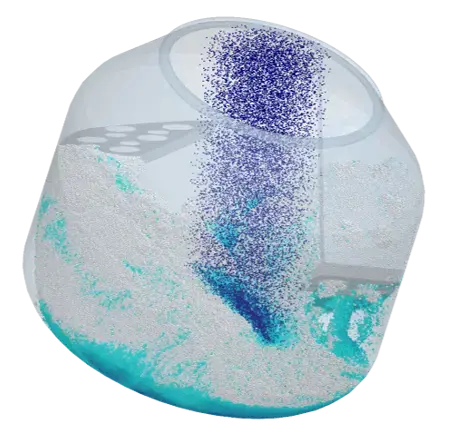
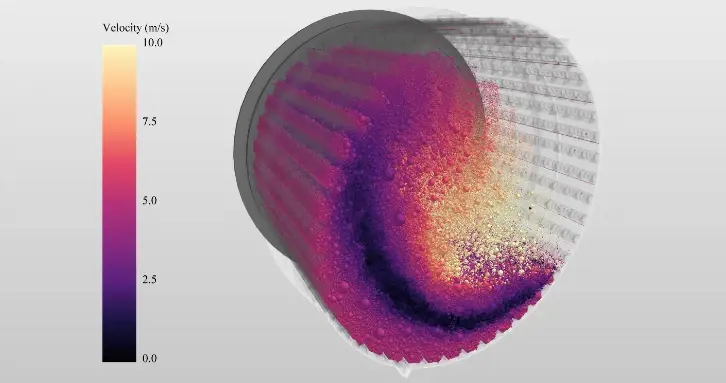
Altair EDEM is high-performance Discrete Element Method (DEM) software used to simulate and analyze the behavior of particle-based materials such as ores, powders, grains, and fibers. It helps engineers understand how materials move, interact with equipment, and impact performance across industrial processes. EDEM can be used independently or integrated with other CAE tools for more advanced simulations.
Key Features Of Altair EDEM
Explore the core capabilities that enable accurate, scalable, and high-performance particle simulations.
Realistic Bulk and Granular Material Simulation
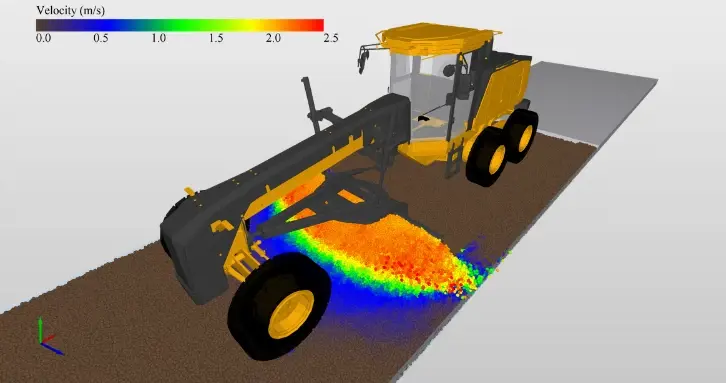
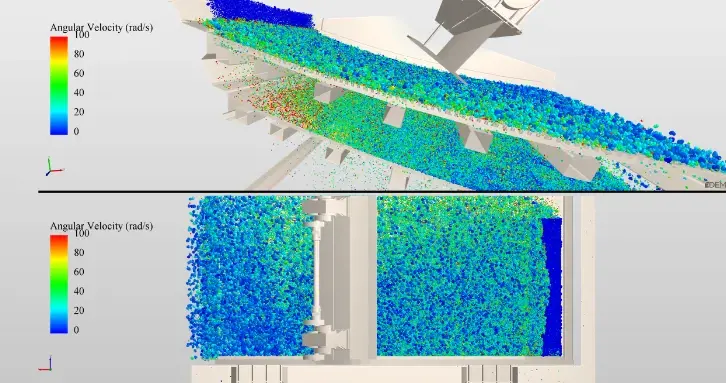
EDEM uses the Discrete Element Method to simulate how bulk and granular materials behave and interact with equipment. It supports a wide range of material types and material behaviors, including dry, sticky, and compressible behavior.
High-Performance Solver for Large Particle Systems
EDEM provides scalable solver performance across CPU, GPU, and multi-GPU options, making it suitable for large and complex particle simulations. Altair positions it for simulations involving millions or tens of millions of particles.
CAE Coupling for Broader Engineering Workflows
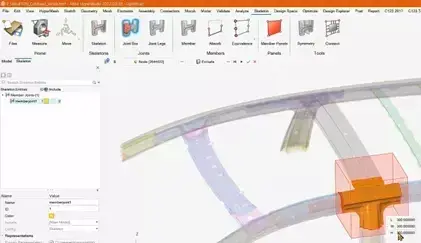
EDEM can be coupled with other CAE tools to extend particle simulation into broader engineering studies. Official Altair sources support coupling with CFD, FEA, and multi-body dynamics workflows for fluid-particle interaction, structural loading, and equipment motion studies.
EDEM Capabilities
Key tools for building, controlling, and analyzing realistic particle simulations.
CAD Geometry Import and Equipment Setup
EDEM Creator supports importing equipment geometry from common CAD formats including IGES, STL, and STEP, helping users build simulation environments around real equipment shapes. Geometry sections can also be imported as part of model setup.
Motion Definition for Equipment Behavior
Users can assign equipment motion in EDEM Creator, including linear, rotational, sinusoidal, force-driven, and torque-driven motion. This supports studies where bulk material behavior depends on moving machinery or process equipment.
Particle Shape Modeling
EDEM supports Multi-Sphere, Polyhedral, and Sphero-Cylinder particle shapes. Documentation also shows support for imported CAD geometry in polyhedral definitions and sphere fitting for creating complex shapes.
Material Definition and Interaction Setup
EDEM Creator includes bulk material setup and the definition of interactions between materials and geometry. The material workflow is supported by material data transfer tools and starter resources in the documentation.
Material Calibration Tools
EDEM includes EDEM Cal and EDEM Calibration Kits to support material model calibration using standard bulk solids characterization tests. The calibration kits also include Python scripts for computing and reporting standard test results.
Physics Models for Material Behavior
EDEM includes validated physics models and documented support for contact models such as Hertz-Mindlin, JKR, Edinburgh-Elasto-Plastic-Adhesion, Bonded V2, and wear models including Archard Wear and Relative Wear. This is one of the key foundations for representing a range of bulk material behaviors.
Custom Physics and API Extensibility
EDEM provides an API for implementing user-defined contact physics, particle-generation factories, and external couplings through plugins. This makes it possible to extend the software for advanced or highly specific particle behavior.
Coupling Interfaces for CFD and MBD
The EDEM Coupling Interface supports coupled simulations with generic CFD codes and rigid or multi-body dynamics codes, allowing two programs to operate synchronously and share data during a coupled simulation. Solver capability tables also confirm support for CFD and MBD coupling interfaces.
Analysis, Visualization, and Query-Based Review
EDEM Analyst provides tools to review and examine simulations, including clipping, field display, graphs, geometry bins, grid bins, and query-driven data extraction. It also supports continuum-based analysis views for interpreting particle data as a continuum.
Data Export and Downstream Use
Users can export simulation data from single time steps, time ranges, selected elements, or bin groups. Documentation also supports export paths for pressure and force data suitable for HyperMesh and SimSolid, plus geometry and particle export to CAD files and image export during simulation.
Python Access with EDEM py
EDEM py is included for accessing EDEM .h5 data files and supports both pre-processing and post-processing through the Python ecosystem. This is useful for teams that want custom analysis, automation, or reporting workflows around EDEM data.
Expert EDEM Support from TrueInsight

Support for DEM and related simulation workflows
Licensing, demos, and product guidance
Evaluate, adopt, and use Altair EDEM with practical engineering support that goes beyond software access alone. As an official Altair reseller, TrueInsight supports licensing, guided demos, onboarding, and hands-on assistance for engineering teams working with simulation tools across the Altair portfolio.
Articles & Resources
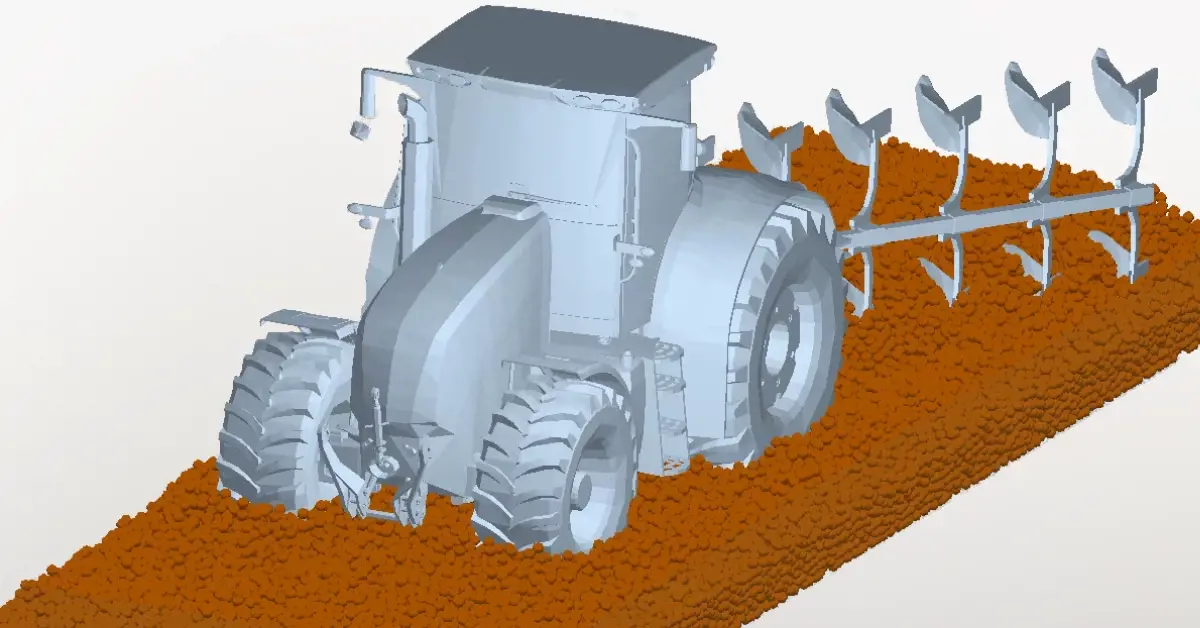
The Many Uses of Altair EDEM
This blog explores the various industries that benefit from using Altair EDEM including mining, steelmaking, pharmaceuticals and agriculture.
Read Article →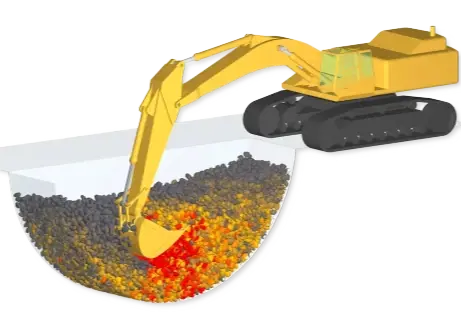
Introduction to Altair EDEM for Discrete Modeling
Discrete Element Method is a leading Simulation program used to accurately model the bulk behavior of granular materials. Learn more its capabilities now!
Read Article →
Manufacturing Analysis
Predict production issues early and validate manufacturing processes before tooling, machining, or full-scale production.
Learn More →Frequently Asked Questions
Altair EDEM is used to simulate how bulk and granular materials behave and interact with equipment. It is commonly used to study flow behavior, material loading, wear-related behavior, and process performance.
Yes. EDEM is a Discrete Element Method software tool built for bulk and granular material simulation. DEM is the core method behind the product.
Yes. Altair documents coupling interfaces for CFD and multi-body dynamics, and the product page also positions EDEM for coupling with FEA, MBD, and CFD workflows.
Yes. EDEM supports CPU, GPU, and multi-GPU solving, and Altair positions that performance for large particle systems.
Yes. EDEM supports Multi-Sphere, Polyhedral, and Sphero-Cylinder particle shapes, with documentation also covering imported CAD-based particle definitions for polyhedral shapes.
Yes. EDEM includes EDEM Cal, calibration kits, EDEM Analyst for visualization and review, and EDEM py for Python-based data access and post-processing.
Ready To Take The Next Step With EDEM?
Whether your team is just starting with EDEM or expanding how it is used internally, TrueInsight provides a direct path to sales guidance, technical support, and engineering-led help through its Altair practice.