
TrueInsight
Siemens/Altair Channel Partner
Menu


Simcenter STAR-CCM+ vs. the Field: Where Simcenter STAR-CCM+ Stands Out
See how Simcenter STAR-CCM+ compares to the CFD competition including Ansys Fluent in this post.
If you're evaluating CFD software for complex fluid scenarios, the shortlist almost always comes down to a few names: Simcenter STAR-CCM+ from Siemens and Ansys Fluent. Both are mature, proven solvers trusted across automotive, aerospace, energy, and electronics. Either one will give you accurate answers to a well-posed flow problem.
So the question is "which tool fits the way my team needs to work?" For teams that want to simulate complex, real-world products quickly, across multiple physics, and repeatedly as designs change, STAR-CCM+ has some clear advantages. Here's where it stands out.
One integrated environment, start to finish
STAR-CCM+ was built from the start as a single, unified environment. CAD import and cleanup, geometry editing, meshing, physics setup, solving, and post-processing all happen in one interface and one simulation file.
That matters more than it sounds. When an engineer changes a fillet radius or swaps in a new inlet design, the whole pipeline updates automatically, from geometry through mesh to results. No exporting between tools, no re-applying boundary conditions, no hunting for which version of the mesh went with which run. For teams running many design iterations, that integrated pipeline is often the single biggest productivity gain.
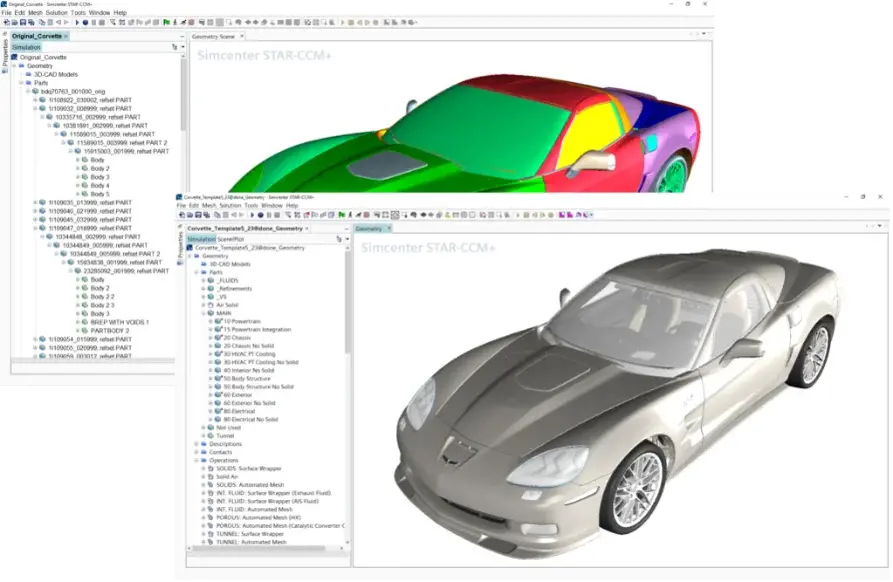
Fig 1: CAD imported into STAR-CCM+
Meshing that handles real-world geometry
Meshing is where many CFD projects lose days. STAR-CCM+ is widely recognized for its automated meshing, and it's one of the most common reasons teams choose it.
- Surface wrapper. Takes messy, non-watertight CAD (gaps, overlaps, missing parts) and produces a clean, closed surface without hours of manual repair. Ideal for full-vehicle, engine-bay, or large assembly models.
- Polyhedral meshing. Polyhedral cells typically reach a converged solution with fewer cells than tetrahedral meshes, which means faster runs and less memory.
- Trimmed (hex-dominant) and thin meshers. Efficient options for external aerodynamics and thin solids like heat sinks, plates, and electronics enclosures.
- Automatic prism layers. Boundary-layer resolution near walls is generated as part of the same automated pipeline.
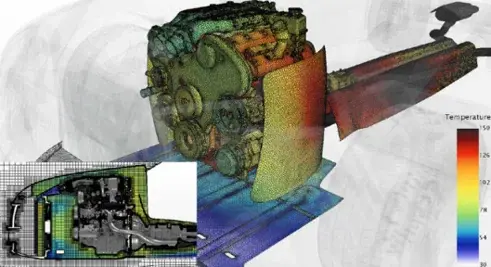
Fig 2: Combination of polyhedral, trimmer and thin meshers for solid and fluid regions in a vehicle thermal management study.
Now with the acquisition of Altair, their HyperMesh CFD preprocessing tool is also part of the Siemens ecosystem, which gives users other options for making sure the most important part of the simulation process (the meshing and setup) is accurately depicted. The net effect: engineers spend their time on engineering decisions, not on cleaning up geometry.
Multiphysics in a single tool
Real products rarely involve just one type of physics. A few examples include: A battery pack is a thermal, electrochemical, and flow problem at once; An electric motor couples electromagnetics, heat, and cooling flow; A spray system mixes droplets, evaporation, and turbulence.
STAR-CCM+ can handle a broad range of these, in the same environment:
- Conjugate heat transfer between fluids and solids
- Multiphase flow, including VOF, Eulerian, Lagrangian particles, and DEM
- Fluid-structure interaction with a built-in finite element solid stress solver
- Electromagnetics and battery simulation
- Combustion, chemistry, and aeroacoustics
- Overset meshes and motion for rotating or moving parts
Because these physics share a mesh, interface, and workflow, coupling them doesn't mean stitching separate products together. That makes it practical to simulate the system the way it behaves, rather than splitting it into simplified pieces.
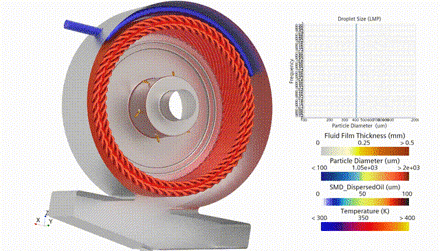
Fig 3: Mixture multiphase simulation in STAR-CCM+
Built for automation and design exploration
The most valuable simulation isn't a single run. It's understanding how a design performs across dozens or hundreds of variations. STAR-CCM+ makes that practical in a few ways:
- Simulation Operations let you script repeatable workflows, such as remesh, run, export results, and move to the next case, without writing code.
- Java macros give full programmatic control for teams that want to automate standardized processes or build in-house tools.
- Design Manager runs parameter sweeps and design studies directly inside STAR-CCM+.
- Simcenter HEEDS integration adds optimization algorithms that search the design space intelligently instead of testing every combination.
The result is a shift from "Does this design work?" to "What's the best design?", earlier in the development cycle when changes are cheapest.
How to Decide
STAR-CCM+ is likely the stronger fit if your team:
- Works with complex or messy CAD assemblies
- Needs multiple coupled physics in one model
- Runs frequent design iterations or optimization studies
- Plans to scale up on HPC clusters, the cloud, or GPUs
The best way to know is to test it on your own geometry. TrueInsight helps engineering teams evaluate Simcenter STAR-CCM+ with a benchmark on a real project, along with licensing guidance and training to get your team productive fast.
Ready to see how STAR-CCM+ handles your toughest simulation? Contact TrueInsight to set up a demo or benchmark.