
TrueInsight
Siemens/Altair Channel Partner
Menu

Simcenter PhysicsAI: AI-Powered Design Exploration Comes to STAR-CCM+
Siemens announces that Simcenter Physics AI is now available for users to predict CFD models using AI technology.
If you've ever sat waiting on a CFD run wondering how many design variants you won't get to test before the deadline, this one's for you. Siemens has launched Simcenter PhysicsAI, a new add-on that brings geometric deep learning into Simcenter STAR-CCM+ and it changes the math on how many designs you can explore.
What It Does
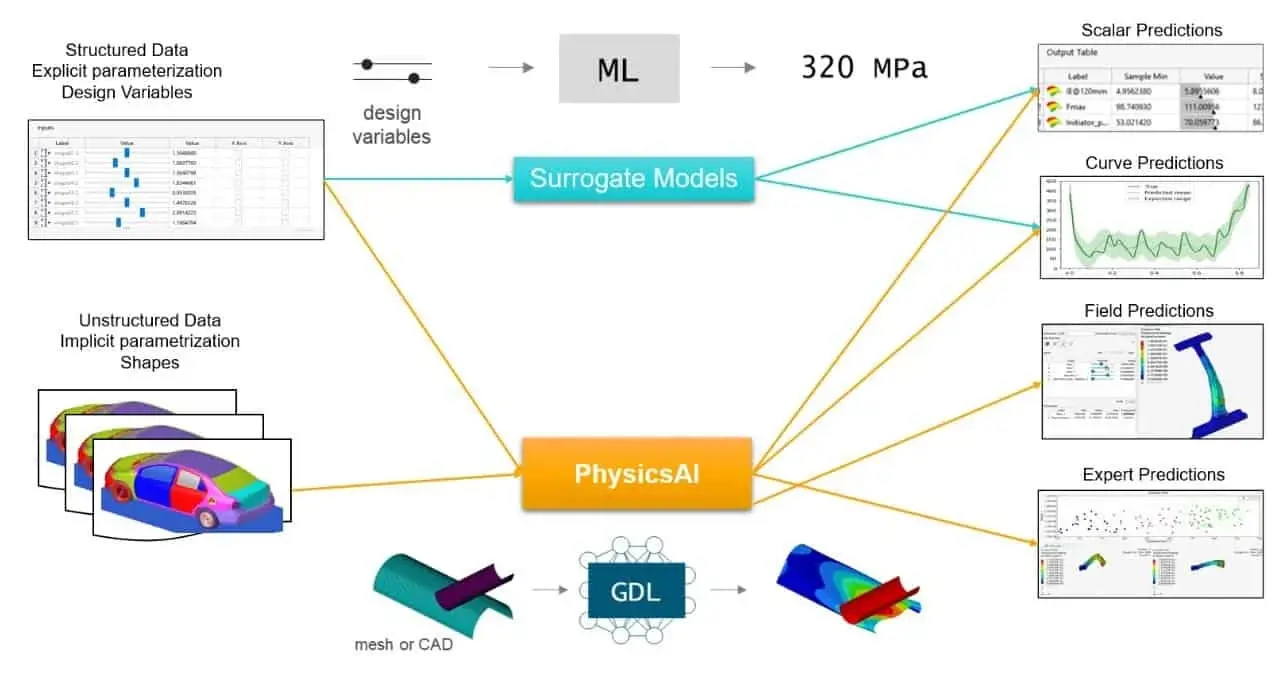
Simcenter PhysicsAI lets you train AI reduced-order models (ROMs) directly from your CFD simulation data. Once trained, those models can predict performance on new geometries almost instantly: no full solver run required. The workflow stays inside your simulation environment, and high-fidelity CFD remains the validation reference, so you're never trading away deterministic accuracy. You're just deciding when you need it.
The training side uses a transformer neural network architecture optimized for geometric data, and it can learn from work you've already done historical results and prior Design of Experiments (DOE) studies so you're not rerunning simulations just to feed the model.
Why It Matters
The bottleneck in simulation has never really been the physics. It's how many possibilities you can afford to explore before a decision has to be made. Siemens' Sam Mahalingam put it well: “Simulation is limited by how quickly we can explore, and the goal here is to make deterministic truth "scalable and immediate" not replace it.".
In practice, that means:
- Screen thousands of design variants in minutes. Instead of queuing solver runs for each one.
- Shift early-stage screening to AI inference. Then plug AI ROMs into optimization studies to evaluate hundreds of variants in hours rather than weeks.
- Trust the predictions. Built-in error metrics and validation tools quantify accuracy, so you know the model is capturing real performance trends.
- Run it fast. PhysicsAI is GPU-accelerated, with predictions up to 100x faster on GPU than CPU.
The pattern will feel familiar if you've followed Altair PhysicsAI, which we've covered on this blog before, train on the simulation data you already have, predict on geometry you haven't solved yet, and save the expensive solver time for the designs that earn it. Now that same approach is native to the STAR-CCM+ ecosystem.
Our Take
AI surrogate modeling is quickly moving from "interesting research demo" to standard practice in CFD-driven design, and PhysicsAI's tight integration with STAR-CCM+ removes most of the friction that kept teams from adopting it. If your team is solver-limited during concept exploration, and most are, this is worth a serious look.
Want to see what Simcenter PhysicsAI could do with your CFD data? Reach out to the TrueInsight team and we'll help you get started.