
TrueInsight
Siemens/Altair Channel Partner
Menu

Altair Radioss | Crash Simulation Software & Explicit Dynamics
Altair Radioss is an industry-leading explicit solver for highly nonlinear, dynamic events, crash, impact, blast, and ballistics. With multiphysics capability and strong scalability, TrueInsight helps you adopt Radioss faster with licensing, onboarding, and engineering-led guidance.
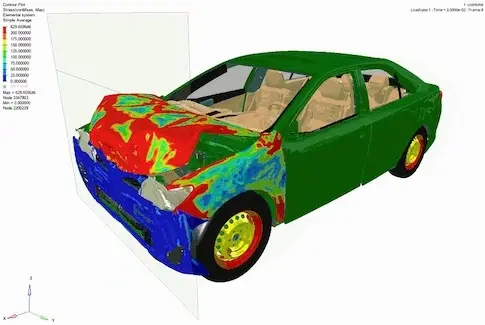
Explicit Dynamics Simulation
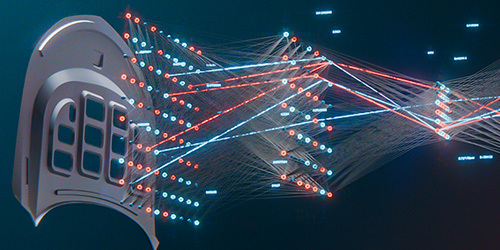
Advanced Crash and Impact Simulation with Altair Radioss
Simulate crash, impact, and nonlinear events with industry-leading accuracy.
Altair Radioss is a leading explicit dynamics solver designed to handle highly nonlinear scenarios such as crashworthiness, drop tests, and high-velocity impacts. As an official Altair partner, TrueInsight helps engineering teams implement Radioss to predict structural behavior under extreme conditions, including material failure, large deformations, and complex contact interactions. Optimize product safety, reduce physical prototyping, and accelerate development with advanced simulation workflows.
Key Capabilities of Altair Radioss
Explicit dynamics simulation for crash, impact, and nonlinear analysis.
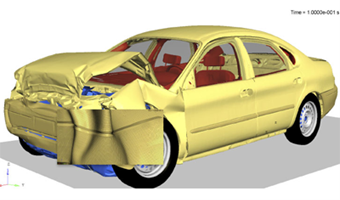
Crash & Impact Simulation
Simulate high-speed collisions and impact events with precision. Altair Radioss enables engineers to analyze crashworthiness, predict structural failure, and improve safety performance before physical testing.
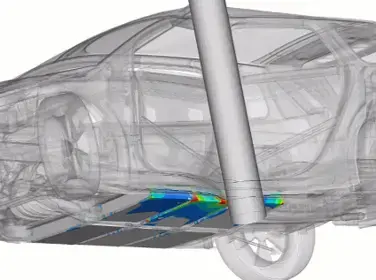
Nonlinear Structural Analysis
Handle complex nonlinear behavior including material failure, large deformations, and contact interactions. Radioss is designed for scenarios where traditional linear methods are not sufficient.
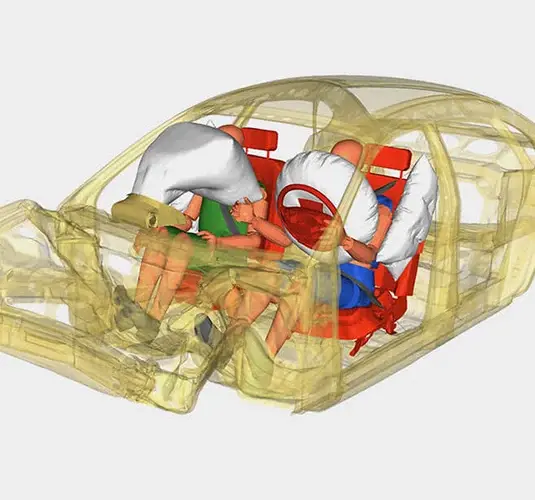
Advanced Material Modeling
Accurately represent real-world materials under extreme conditions. From metals to composites, Radioss supports advanced material models for reliable and realistic simulation results.
Altair Radioss Capabilities
Explicit dynamics simulation for crash, impact, and extreme nonlinear scenarios.
Crashworthiness & Safety Simulation
Altair Radioss is built for crash and safety scenarios involving large deformations, complex contact, and nonlinear materials. It enables full-system simulation to accurately predict structural behavior and improve safety performance under extreme loading.
Impact and Drop Events
Simulate high-speed impact and drop events with precise contact handling and energy transfer. Radioss helps engineers evaluate intrusion, peak loads, and structural response over time in highly dynamic conditions.
Blast and Ballistic Analysis
Handle extreme transient load cases such as blast and ballistic events. Radioss supports high strain-rate scenarios, making it suitable for designing and validating protective structures under severe dynamic conditions.
Advanced Interaction Modeling (ALE & SPH)
Model complex physical interactions beyond standard contact using advanced explicit methods like ALE and SPH. This enables more realistic simulation of fluid-structure and highly dynamic interactions.
Solver Deck Compatibility
Reduce workflow friction by reusing existing solver input decks. Radioss allows teams to migrate or consolidate simulation processes without rebuilding models from scratch, improving efficiency and consistency.
Scalable Performance for Large Models
Run large explicit simulations efficiently with scalable performance. Radioss is optimized to handle complex models while maintaining fast turnaround times and high simulation fidelity.
Radioss Services

Expert Altair Radioss Support and Engineering Services
Accelerate adoption and improve simulation accuracy with expert guidance.
TrueInsight goes beyond providing Altair Radioss licenses. We support engineering teams with onboarding, workflow optimization, and model validation to ensure reliable results in crash, impact, and explicit dynamics simulations. From initial setup to advanced troubleshooting, our experts help you reduce errors, improve model quality, and deliver accurate simulations faster.
Learn More About Altair Radioss
Real-world simulations powered by explicit dynamics and advanced engineering methods.
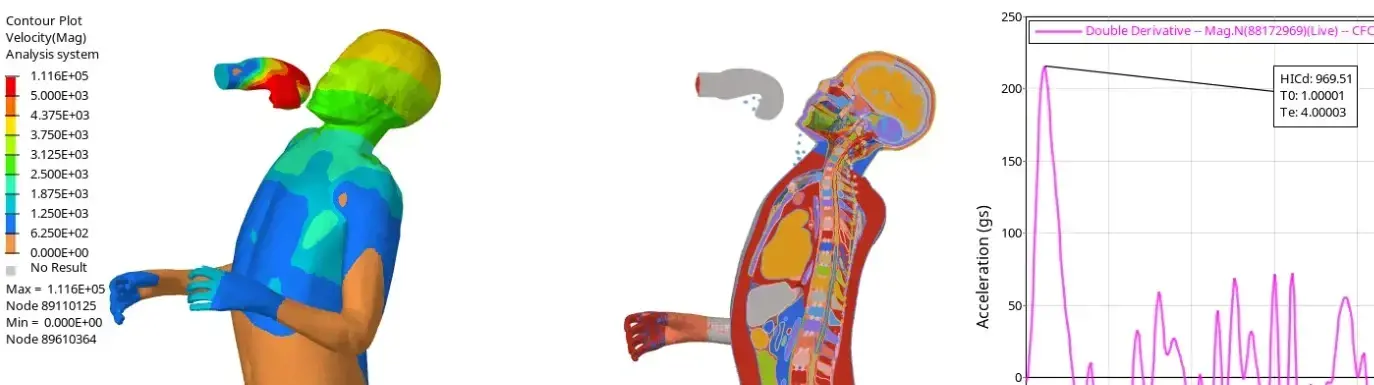
Simulating the Impact of a Mike Tyson Punch
Radioss can model the human head with detailed representation of tissues, bones, and muscles to simulate high-speed impacts. By applying real-world parameters such as punch velocity and mass, engineers can analyze force distribution, deformation, and strain across the skull and facial structures.
Explore capability →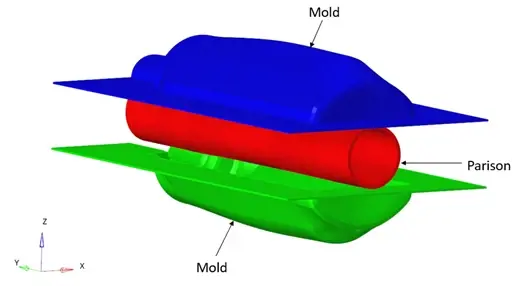
Blow Molding Simulation with Radioss AMS
Altair Radioss Advanced Mass Scaling (AMS) accelerates blow molding simulations while preserving accuracy. It reduces computation time significantly without compromising stress, strain, or energy balance, making it ideal for complex manufacturing processes.
Explore capability →Customer Success Stories
Radioss Users in Action
.webp)
IDES – Defence Vehicle Module in Record Time
Australian engineering firm IDES used Altair Radioss to design a rollover protection structure (ROPS) for the Army’s G-Wagon. By simulating pendulum crash tests virtually, they eliminated costly physical prototypes and delivered a robust, life-saving solution within strict project deadlines.
Explore capability →
Arcimoto – Safe Fun Utility Vehicle (FUV)
Arcimoto leveraged Altair Radioss to develop its electric three-wheeled vehicle, validating roof crush, roll cage, and structural performance through simulation. This approach enabled rapid development of a safe, efficient vehicle while minimizing costs in a startup environment.
Explore capability →
Outstanding Scalability at NIAR
The National Institute for Aviation Research (NIAR) demonstrated Radioss scalability using multi-domain crash simulations on cloud infrastructure. Radioss achieved significantly faster performance than competing solvers while maintaining consistency across large-scale HPC simulations.
Explore capability →Frequently Asked Questions
Radioss is used for explicit dynamics simulation, especially crash, impact, drop tests, blast, and ballistic events where large deformation, complex contact, and failure behavior happen in milliseconds and must be captured realistically.
Radioss is the explicit dynamics solver behind many crash and impact workflows. In practice, teams refer to it as crash simulation software because it’s the engine running the physics for crashworthiness and safety studies.
Choose Radioss when the event is highly nonlinear and fast: large contact interactions, severe deformation, material failure, or short-duration impacts. Implicit solvers are great for quasi-static or slowly evolving problems; Radioss is built for violent, transient events.
Often, yes. Radioss is known for input deck compatibility, which can reduce switching friction and preserve prior validation baselines. The right approach depends on your current deck type and modeling conventions, but it’s a major advantage when migrating workflows.
OpenRadioss is the open-source path related to the Radioss solver ecosystem. Teams typically evaluate it when they want openness and portability, while commercial Radioss is commonly chosen for production programs that prioritize enterprise-grade deployment, support, and integrated workflows.
We help you get value fast, onboarding, workflow setup, model review, and practical best practices for explicit crash/impact simulations. If you’re migrating from another solver, we also help you reduce risk through benchmarking and deck transition guidance, so your results stay consistent and defensible.
Ready to Take the Next Step with Radioss?
Talk to TrueInsight about Altair Radioss licensing, onboarding, and expert help for crash simulation software workflows so your team can move faster with more confidence.